Outbound Reps’ Role in Agency Pipeline Growth
Outbound reps generate the qualified meetings that fund every agency pipeline. Here’s the targeting, KPIs, and handoff structure that actually compound.
Qas
June 9, 2026

Outbound representatives are the proactive sales professionals responsible for generating qualified, top-of-funnel meetings that feed an agency’s revenue pipeline. The role of outbound reps in agency pipeline development is not passive. They target ideal customer profiles, run multi-channel sequences across email, LinkedIn, and phone, and deliver booked appointments to account executives (AEs) who close deals.
Without this function, most agencies depend entirely on referrals and inbound leads, which creates fragile, unpredictable revenue. Sales leaders who treat outbound reps as a strategic asset — not a volume play — build pipelines that compound over time.
How do outbound reps contribute to agency pipeline growth?
Outbound reps generate the qualified meetings AEs need to maintain a full opportunity pipeline. Their primary output is not revenue itself. It is the booked, attended meeting with a prospect who fits the agency’s ideal customer profile (ICP). Every other activity feeds that single goal.
- ICP targeting: Reps work a tightly scoped prospect list. 200 carefully-defined prospects beat 2,000 loosely-targeted ones.
- Multi-channel sequencing: Coordinated outreach across email, LinkedIn, and phone — each channel reinforces the others.
- Meeting qualification: Reps confirm budget authority, need, and timeline before handing off to AEs.
- AE collaboration: Reps brief AEs before each meeting with prospect pain points, company size, and prior interactions.
The outreach volume-versus-quality debate is settled. Volume without targeting burns rep time and poisons AE calendars with dead-end meetings. Quality targeting, even at lower volume, produces pipeline that moves.
Pro TipBuild your ICP around the last five clients your agency closed fastest. Those attributes — industry, company size, decision-maker title — define your highest-conversion prospect profile.

What KPIs measure outbound reps’ effectiveness?
Measuring outbound rep performance correctly separates agencies that scale from those that spin their wheels. The most important appointment-setting KPIs are contact-to-meeting rate, meeting show rate, meeting-to-opportunity conversion rate, cost per booked meeting, cost per qualified lead, and cost per closed deal. Each links rep activity directly to revenue.
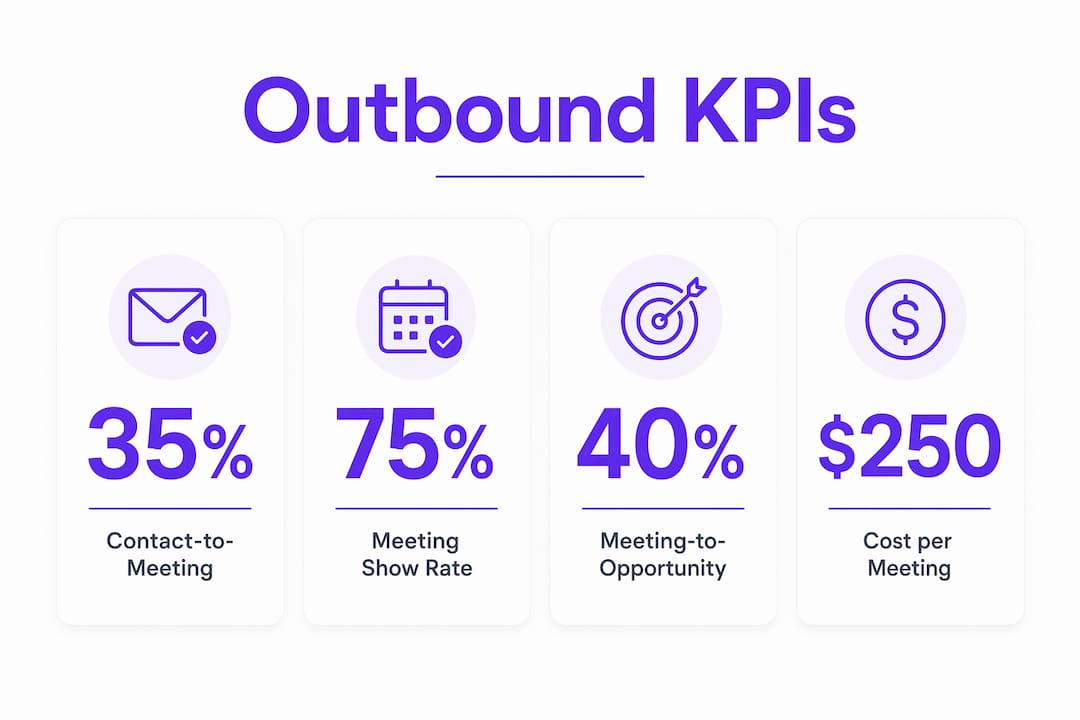
| KPI | What It Measures | Why It Matters |
|---|---|---|
| Contact-to-meeting rate | Percentage of prospects who book a call | Shows targeting and messaging quality |
| Meeting show rate | Percentage of booked meetings that actually happen | Reveals confirmation and nurture discipline |
| Meeting-to-opportunity rate | Percentage of meetings that become active deals | Measures qualification accuracy |
| Cost per qualified lead | Spend divided by qualified meetings generated | Tracks economic efficiency of outbound |
| Cost per closed deal | Total outbound cost divided by deals won | Connects rep activity to revenue ROI |
One critical mistake agencies make is tracking dial volume and email send counts as primary metrics. These are activity metrics, not outcome metrics. A rep sending 500 emails per week with a 0.1% meeting rate is less valuable than a rep sending 100 targeted emails with a 4% meeting rate.
There is also a timing problem. Conversion outcomes often appear 28+ days after initial outreach. Agencies that optimize on short-term signals like open rates or reply rates end up making decisions based on misleading data. Cohort-based measurement gives a far more accurate picture.
Pro TipReview KPIs in 30-day cohorts, not weekly snapshots. Weekly data on outbound performance is almost always too early to be meaningful.
What operational processes support outbound reps’ success?
Operational discipline is what separates an outbound function that scales from one that stalls. The most common failure is not poor messaging — it is broken workflows that let warm prospects go cold.
Structured pipeline stages and ownership
A clearly defined CRM pipeline with explicit ownership and exit criteria for each stage stops deals stalling silently. Reps need to know exactly what triggers movement from “contacted” to “meeting booked” to “handed off.”
SDR-to-AE handoff mechanics
The SDR-to-AE handoff is the primary structural fault line in most outbound pipelines. Most handoffs fail silently, losing prospects unless defined triggers and SLAs are enforced. Best practice requires three things: a defined trigger that initiates the handoff, a structured handoff record, and an SLA for the AE’s first contact.
| Handoff Element | Best Practice |
|---|---|
| Trigger | Defined event, such as prospect confirming meeting attendance |
| Handoff record | Structured fields: company, contact, pain points, budget signals, prior touches |
| AE SLA | First contact within 24 hours of handoff |
| Shared definitions | Both SDR and AE agree on what “qualified” means before handoff |
Pipeline tools vs. spreadsheets
Purpose-built pipelines with automatic reminders, call history tracking, and duplicate-call prevention maintain outbound momentum far better than spreadsheets. Spreadsheets typically fail above 30–50 active leads because they lack workflow features. When scaling to multiple reps, the problem compounds.
Pro TipIf your team manages more than 50 active leads and still uses a spreadsheet, you are losing warm prospects to follow-up gaps. Move to a purpose-built CRM before adding more reps.
Does multi-channel outreach outperform single-channel methods?
Multi-channel outbound sequences are definitively more effective than single-channel approaches. Combining email with LinkedIn and phone increases engagement and booking rates 2–3× compared to single-channel methods. The reason is recognition.
- Recognition building: Repeated exposure across channels creates familiarity before a direct ask.
- Message reinforcement: Each channel can emphasize a different angle of the same value proposition.
- Timing flexibility: Different prospects respond to different channels.
- Trust acceleration: Coordinated outreach signals professionalism to senior decision-makers.
What pitfalls undermine outbound reps’ pipeline impact?
- Poor ICP targeting: Loosely-defined prospect lists generate meetings AEs cannot close.
- Undefined handoff processes: Prospects fall through the gap between SDR and AE.
- Spreadsheet-based pipeline management: Above 50 active leads, spreadsheets create duplication and lost context.
- Activity-volume obsession: Celebrating dial counts over meeting-to-opportunity rates optimizes for the wrong outcome.
Outbound reps are not standalone lead sources. They are part of a strategic sequence that works best when aligned with inbound credibility efforts.
The most overlooked pitfall is launching outbound before any market recognition exists. Outbound running ahead of market recognition forces reps to build credibility from zero, slowing conversion.
Key takeaways
| Point | Details |
|---|---|
| Targeting quality over volume | 200 well-defined prospects outperform 2,000 loosely-targeted ones. |
| KPIs must link to revenue | Track contact-to-meeting, show rate, and cost per closed deal — not dial counts. |
| Handoffs need structure and SLAs | Define triggers, structured records, and 24-hour AE first-contact SLAs. |
| Multi-channel outreach multiplies results | Email + LinkedIn + phone increases booking rates 2–3×. |
| Pipeline tools beat spreadsheets at scale | Purpose-built CRMs prevent warm leads going cold above 50 active contacts. |
Why most agencies get outbound backwards
I have seen this pattern more times than I can count. An agency owner hires two outbound reps, gives them a broad list, and expects a full pipeline within 30 days. When it does not materialize, the conclusion is that outbound does not work. The real problem is almost always sequencing and structure, not the reps themselves.
Agencies that build durable outbound pipelines invest in ICP clarity before the first call, and treat the SDR-to-AE handoff as a product — not an afterthought. They write it down, define the fields, set the SLA, and review it monthly.
Outbound is a capability that compounds. The first 90 days rarely produce the best results. Commit to a 6-month horizon and measure in cohorts.
Scale your outbound pipeline with RepMatch
Building an outbound function from scratch takes time most agency owners do not have. RepMatch connects agencies with vetted commission-only reps assessed through live roleplay before placement — removing the risk of hiring reps who cannot perform under real conditions.
Clients report an average of 42 booked calls per rep monthly and a 546% increase in show rates. If you are ready to add qualified outbound capacity without a lengthy recruitment process, hire commission-only reps and have your first rep placed within 14 days.
FAQ
What is the primary role of outbound reps in an agency pipeline?
Outbound reps generate qualified, top-of-funnel meetings that feed account executives’ pipeline. Their core output is the booked, attended meeting with a prospect who fits the agency’s ICP.
Which KPIs best measure outbound rep performance?
Contact-to-meeting rate, meeting show rate, meeting-to-opportunity conversion rate, and cost per closed deal. These metrics link rep activity directly to revenue.
Why do SDR-to-AE handoffs fail and how can agencies fix them?
Most handoffs fail because there is no defined trigger, structured record, or SLA. Fix this with a written handoff artifact and a maximum 24-hour SLA for AE first contact.
How does multi-channel outreach improve pipeline results?
Multi-channel sequences combining email, LinkedIn, and phone increase booking rates 2–3× compared to single-channel outreach. Repeated exposure builds recognition before a direct meeting request.
When should an agency start scaling outbound reps?
Establish some market visibility through case studies, LinkedIn presence, or content before scaling outbound. Outbound ahead of market recognition forces reps to build credibility from zero.