How to Handle Sales Rep Churn at Your Agency
A single SDR departure costs £115k–£195k. The fix: a 30-60-90 transition playbook, stay interviews, and airtight commission accuracy — built as one system.
Qas
June 10, 2026

Sales rep churn is the rate at which sales representatives leave an organization, and for agencies it is one of the most expensive operational problems you will face. A single SDR departure costs startups between $115,000 and $195,000 once you factor in recruiting, lost pipeline, ramp time, and knowledge loss. That number alone reframes how you think about retention. The most effective way to handle sales rep churn at an agency combines three pillars: a structured transition playbook, proactive stay interviews, and airtight compensation accuracy.
How to handle sales rep churn with a transition playbook
The industry term for managing rep departures is “sales transition management,” and most agencies do it badly. The default is a rushed handoff, a few forwarded emails, and a hope that customers stay loyal. That approach fails consistently.
Structured 30-60-90 day transition playbooks retain 84% of a departing rep’s customers, compared to just 52% for ad-hoc transitions. That 32-point gap represents real revenue. The playbook works because it forces deliberate action at every stage instead of letting things fall through the cracks.
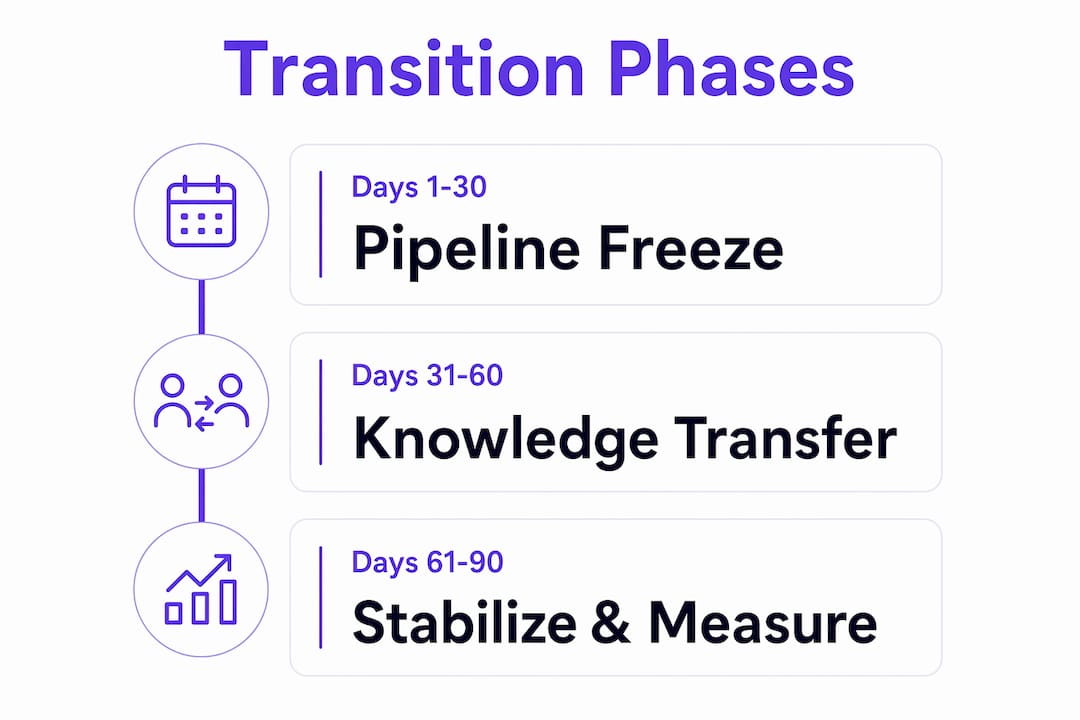
The 30-day phase: stop the bleeding
The first 30 days are about control. The moment a rep announces their departure, freeze their pipeline. No new deals should enter their ownership without explicit manager approval. This prevents a “silent transition,” where a rep quietly stops advancing deals or, worse, poisons customer relationships on the way out.

Hostile or silent customer handoffs reduce customer retention to 64%, compared to 92% for amicable, planned transitions. In this phase, sales managers should conduct a pipeline triage call with RevOps to categorize every open deal by risk level and assign interim ownership.
The 60-day phase: transfer knowledge and relationships
Days 31 through 60 focus on knowledge capture and warm customer communication. The departing rep should record Loom-style walkthroughs for every active account, documenting contact preferences, objection history, and deal context. Sales managers should co-own customer introductions, not delegate them entirely to the incoming rep.
RevOps plays a critical role here. They should audit CRM data for completeness, flag any accounts with missing contact records, and build a handoff scorecard that the replacement rep inherits on day one.
The 90-day phase: stabilize and measure
By day 90, the replacement rep should be active and the transition should be measurable. Track customer retention rate, pipeline conversion rate, and time-to-first-meeting for the new rep. Gated outcome metrics like time-to-first-deal are more reliable indicators of transition success than calendar-based task completion.
Pro TipImplement a pipeline freeze policy before any rep gives notice. Require manager approval for any new deal assignment to a rep flagged as a flight risk. This stops revenue leakage before the formal departure process begins.
| Phase | Key Actions | Target Outcome |
|---|---|---|
| Days 1–30 | Pipeline freeze, triage, interim ownership | Zero unmanaged deals |
| Days 31–60 | Knowledge capture, warm customer intros | 90%+ accounts contacted |
| Days 61–90 | New rep activation, outcome tracking | 84% customer retention |
How do stay interviews reduce sales rep turnover?
Stay interviews are 20–30 minute, manager-led conversations held one to two times per year with current employees. They are not performance reviews. They are not check-ins about quota. They are direct conversations about what would make a rep leave and what would make them stay.
The difference between stay interviews and exit interviews is timing. Exit interviews capture reasons after the decision is already made. Stay interviews shift that conversation earlier, capturing preventable turnover causes while there is still time to act. Most reps decide to leave months before they resign.
What makes a stay interview work
The format matters as much as the content. Keep it informal, off-site if possible, and led by the direct manager rather than HR. Reps are more honest with someone who can actually change their day-to-day experience. Ask open questions: “What would make you consider leaving?” and “What’s one thing we could change that would make your work more satisfying?”
The critical rule is follow-through. Taking one concrete action within two weeks of the conversation builds trust and signals that the feedback was real, not performative. Reps who see their input ignored stop giving it. That silence is the precursor to a resignation letter.
- Schedule them at least 60 days before any performance review cycle to avoid conflation.
- Document feedback in a shared retention log visible to sales leadership.
- Prioritize issues that can be resolved within 30 days to show immediate impact.
- Avoid asking about compensation directly in the first interview; let reps surface it naturally.
- Follow up in writing within 48 hours with a summary of what you heard and what you will do.
Pro TipTackle the fastest, most visible fixes first after a stay interview. Resolving a small friction point quickly — a broken CRM workflow, a meeting cadence — signals responsiveness and builds the psychological safety that keeps reps engaged long-term.
What compensation accuracy does for sales rep retention
Commission errors are a silent churn driver. A rep who gets paid late, paid wrong, or paid without understanding why will start looking for another role before they ever raise a complaint. Missed or error-prone commission payouts erode trust and increase turnover risk faster than most managers realize.
The root cause is usually disconnected systems. When comp plans live in spreadsheets, CRM data lives in Salesforce, and payroll runs through a separate platform, errors multiply at every handoff. A single system of record with a transparent audit history reduces that distrust directly.
Unified plan-to-pay systems
The fix is not more spreadsheet audits. It is a unified plan-to-pay platform that connects quota assignment, deal closure, and commission calculation in one place. Platforms like Spiff, CaptivateIQ, or Xactly give reps real-time visibility into their attainment and earnings. That visibility removes the anxiety of not knowing what a paycheck will look like.
Pro TipAlign RevOps and sales leadership on a monthly comp audit before payroll runs. A 30-minute review of flagged discrepancies prevents the disputes that quietly push top performers out the door.
| Compensation Process | Payout Error Risk | Retention Impact |
|---|---|---|
| Manual spreadsheet tracking | High | Negative — increases disputes |
| CRM-only tracking | Medium | Neutral — limited visibility |
| Unified plan-to-pay platform | Low | Positive — builds trust and clarity |
What should sales managers do to improve rep retention?
Front-line managers have more direct impact on rep retention than any broad organizational program. A manager with a 6–8 rep span who runs consistent retention conversations will outperform a company-wide engagement initiative every time. The math is simple: managers see the daily friction that surveys miss.
Manager retention tactics that work
Quarterly retention conversations are the most underused tool in a sales manager’s kit. A 20-minute, one-on-one conversation focused on career path, workload, and team dynamics gives the manager early signal before a rep starts interviewing. The conversation should not be about performance. It should be about the rep’s experience.
- Run a 20-minute retention conversation every quarter for reps over 12 months in role.
- Track attrition by manager, not just by team, to identify patterns early.
- Build a recognition cadence that is specific and tied to behaviors, not just outcomes.
- Create visible career path options so reps know what promotion looks like.
- Reduce workload friction by auditing non-selling tasks monthly and eliminating low-value ones.
Pro TipMonitor attrition data broken down by manager, not just by department. If one manager consistently loses reps at a higher rate, the issue is rarely the reps. Address the management behavior directly before it becomes a team-wide problem.
Key takeaways
| Point | Details |
|---|---|
| Transition playbooks save revenue | Structured 30-60-90 day handoffs retain 84% of customers vs 52% for ad-hoc exits. |
| Stay interviews beat exit interviews | Running stay interviews 1–2 times yearly captures preventable churn early. |
| Compensation accuracy is a retention tool | Unified plan-to-pay systems reduce disputes and build trust. |
| Managers drive retention more than programs | Front-line managers with 6–8 reps running quarterly conversations win. |
| Early intervention is the only intervention | Retention decisions are made months before resignation. |
The uncomfortable truth about sales rep churn
I have watched startup sales leaders treat churn as a recruiting problem. Their instinct when a rep leaves is to open a job req and move on. That instinct is expensive and wrong.
The agencies that handle churn well treat retention as an operational function, not an HR project. That means assigning it to front-line managers with clear accountability, building it into RevOps workflows, and measuring it with the same rigor you apply to pipeline coverage.
The 30-60-90 transition playbook, stay interviews, and compensation accuracy are not three separate initiatives. They are one system. Build all three or the weakest link will cost you.
How RepMatch helps you replace reps without losing revenue
When a sales rep leaves, the clock starts immediately. RepMatch places commission-only sales reps in 14 days, giving startup sales leaders a fast path back to full capacity without the financial risk of base salaries.
Our live roleplay assessments filter for closers who can perform from day one. Clients report an average of 42 booked calls per rep monthly and a 546% increase in show rates after onboarding. If you are managing a rep departure right now, book a strategy call to see how RepMatch can fill the gap. You can also review client case studies.
FAQ
What does it cost to lose one sales rep?
A single SDR or AE departure costs between $115,000 and $195,000, including recruiting fees, lost pipeline, ramp productivity loss, and knowledge attrition.
How long should a sales rep transition take?
A structured transition should run 90 days: pipeline freeze and triage in the first 30 days, knowledge transfer and customer communication in days 31–60, and new rep activation with outcome tracking through day 90.
What is a stay interview and how often should I run one?
A stay interview is a 20–30 minute, manager-led conversation held one to two times per year to identify what would cause a current employee to leave. It differs from a performance review by focusing entirely on the rep’s experience and retention risk.
Why do commission errors cause sales rep churn?
Commission errors signal that the company cannot be trusted to pay fairly. Disconnected compensation systems create disputes that erode confidence and accelerate departures, especially among top performers.
How many reps should one sales manager oversee?
Front-line managers perform best with a span of 6–8 reps. That range allows enough time for meaningful coaching, retention check-ins, and early intervention before turnover risk escalates.